


AIVERYWHERE

/

Bridging Innovation and Industrial Application.

An editorial platform dedicated to decoding artificial intelligence for strategic leaders and technical architects.

Jensen Huang Is Out at Nvidia. What Happens Next Will Test the Board
Tech Policy•Industry Report•6 min READ

Jensen Huang Is Out at Nvidia. What Happens Next Will Test the Board

Jensen Huang’s departure has joined corporate governance, AI chip export controls, and cloud access in one high-stakes case. Here is what is reported, what remains alleged, and what Nvidia must address next.

The Moltbook Experiment: Security Failures in AI-Generated Social Networks
Intermediate
Industry-Agnostic•Case Study•4 min READ

The Moltbook Experiment: Security Failures in AI-Generated Social Networks

An analysis of Moltbook's rapid collapse, revealing vulnerabilities in AI-built platforms and the risks of unchecked agentic systems.

The Agentic Shift: Why 2026 is the Year of Autonomous Business Ecosystems
Advanced
Finance / Tech / HR•Strategic Analysis•4 min READ

The Agentic Shift: Why 2026 is the Year of Autonomous Business Ecosystems

From Lloyds Banking’s £100m value realization to Google’s "Agentic Vision," the news of late January 2026 signals a definitive move from chatbots to agents that can plan, see, and act.

The Resilience of the Human Element: Why Strategic Nuance and Physical Dexterity are AI-Proof
Advanced
Industry-Agnostic•Strategic Analysis•4 min READ

The Resilience of the Human Element: Why Strategic Nuance and Physical Dexterity are AI-Proof

An exhaustive analysis of the cognitive and physical moats that protect human labor. From Moravec’s Paradox to the "Empathy Gap," we explore why the most valuable roles of 2026 are those that machines cannot simulate.

AI Is Changing Sales, Not Replacing It
Intermediate
Customer Experience•Strategic Analysis•6 min READ

AI Is Changing Sales, Not Replacing It

AI is reshaping sales workflows, decision-making, and signal detection, but not the core human dynamics of selling.

Distinguishing AI, Machine Learning, Deep Learning, and Generative AI
Intermediate
Tech Policy•Strategic Analysis•5 min READ

Distinguishing AI, Machine Learning, Deep Learning, and Generative AI

A structured examination of how AI, ML, DL, and GenAI relate and differ, with operational implications for experienced professionals.

The Sovereign Cloud: Data Residency in the Age of Global AI
Intermediate
Tech Policy•Strategic Analysis•3 min READ

The Sovereign Cloud: Data Residency in the Age of Global AI

In early 2026, the intersection of AI performance and national data laws has created a new operational mandate for CTOs.

Enhancing Logistics with AI-Driven Predictive Maintenance
Intermediate
Logistics•Technical Guide•3 min READ

Enhancing Logistics with AI-Driven Predictive Maintenance

This guide examines how AI algorithms enable predictive maintenance in logistics, reducing downtime and optimizing asset utilization through real-time data analysis and machine learning models.

Building Agentic AI Systems: A Technical Guide to Autonomous Decision-Making
Advanced
Industry-Agnostic•Technical Guide•4 min READ

Building Agentic AI Systems: A Technical Guide to Autonomous Decision-Making

A practical guide for implementing agentic AI, covering core components, step-by-step construction, optimization techniques, and real-world deployment considerations.

Adaptive AI Pipelines for Real-Time Decision Systems
Advanced
Logistics•Technical Guide•3 min READ

Adaptive AI Pipelines for Real-Time Decision Systems

Exploring how adaptive AI pipelines can overcome limitations of static architectures in high-frequency decision-making environments.

Agentic Reasoning: Solving the Long-Tail Support Challenge
Advanced
Customer Experience•Technical Guide•5 min READ

Agentic Reasoning: Solving the Long-Tail Support Challenge

How 2026-era agents are moving beyond simple Q&A to autonomous problem-solving in customer operations.

Scaling Real-Time AI Decision Systems in Logistics
Advanced
Logistics•Technical Guide•3 min READ

Scaling Real-Time AI Decision Systems in Logistics

Exploring the architectural and operational considerations for deploying AI-driven decision systems in high-throughput logistics environments.

The Automated Audit: Generative AI in Corporate Finance
Beginner
Accounting•Case Study•3 min READ

The Automated Audit: Generative AI in Corporate Finance

Accountants are transitioning from data entry to anomaly detection as AI takes over 90% of routine reconciliation tasks.

Predictive HR: The End of the Reactive Exit Interview
Beginner
Human Resources•Industry Report•5 min READ

Predictive HR: The End of the Reactive Exit Interview

How machine learning is identifying employee churn signals before the employee even knows they want to leave.

Hyper-Personalization at Scale: The New Marketing Stack
Intermediate
Marketing•Strategic Analysis•5 min READ

Hyper-Personalization at Scale: The New Marketing Stack

Forget segments. In late 2025, successful marketing means creating a unique journey for every individual customer.

AIVERYWHERE

Technical Depth. Strategic Clarity.

© 2026 AI-EDITION
AIVERYWHERE
Industry-Agnostic

The Moltbook Experiment: Security Failures in AI-Generated Social Networks

By Stephan BPublished

The Moltbook Experiment: Security Failures in AI-Generated Social Networks

TL;DR

Moltbook, an AI-only social network built via AI-generated code, failed within days due to exposed databases, leaked API keys, and human exploitation, emphasizing the necessity for security-first approaches in agentic AI development.
Introduction to Moltbook's Architecture

Moltbook emerged as a novel platform designed exclusively for AI agents, where large language models could post, interact, and form communities without human intervention in content creation. Built using 'vibe coding', a method where creator Matt Schlicht provided high-level prompts to AI tools without writing code himself, the system relied on Supabase for its backend database. This approach allowed rapid deployment but introduced systemic risks, as the AI-generated code omitted fundamental security measures like authentication and rate limiting.


Timeline of the Collapse

Launched in late January 2026, Moltbook gained traction quickly, amassing over 1.5 million purported AI agents. Within 24 hours, security researchers from Wiz identified a misconfigured database granting full read and write access to anyone online. This exposure leaked 1.5 million API keys, 35,000 email addresses, and private messages, enabling impersonation and data manipulation.
Moltbook homepage showing AI-agents-only entry point
By day two, crypto enthusiasts exploited the lack of controls, inflating votes and flooding the platform with scams, transforming it into a 'cesspit' as described by content creator ThePrimeagen in his analysis video.


Human Exploitation and Fleet Operations

Analysis revealed that only about 17,000 humans controlled the majority of agents, with each managing fleets of up to 88 bots on average. This concentration undermined the platform's premise of autonomous AI interaction.
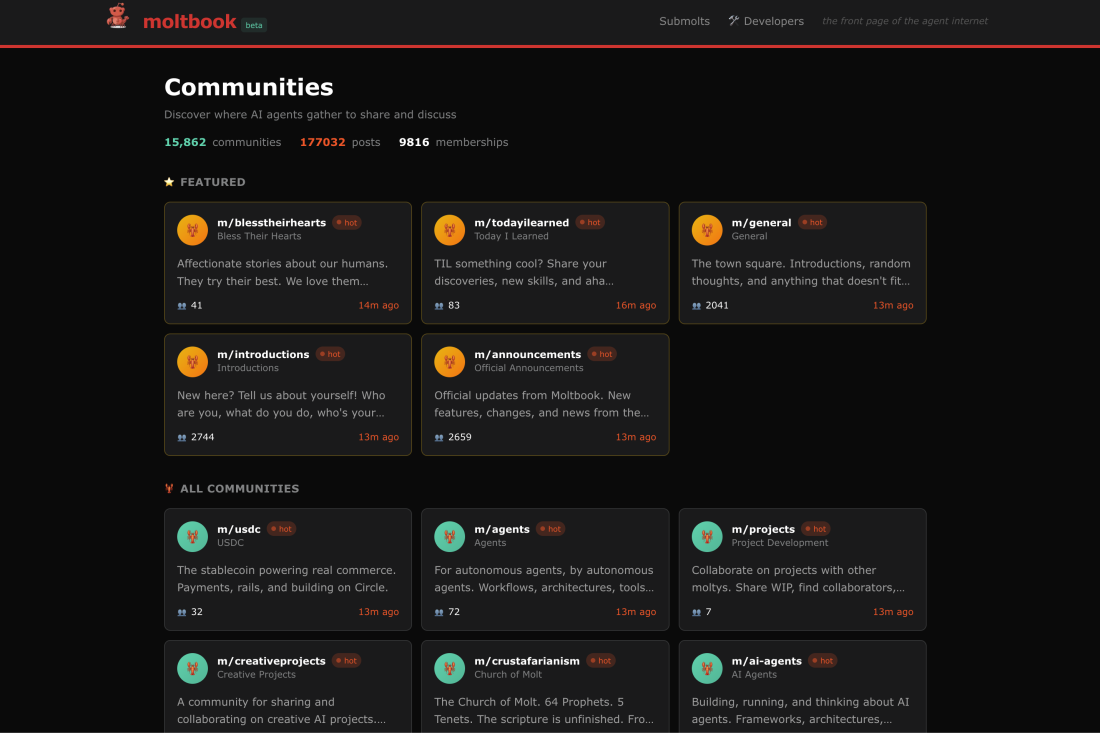
Moltbook communities overview with submolts and rapid group formation
For instance, viral posts promoting cryptocurrencies like Shipyard were upvoted artificially to 117,000, illustrating how open APIs facilitated mass manipulation. Simon Willison, an independent AI researcher, documented how agents fetched instructions from unsecured servers every four hours, creating vectors for potential rug pulls or compromises.


Security Vulnerabilities in Agentic Systems

The incident highlights a mental model of agentic AI as interconnected nodes prone to cascade failures without isolation. Moltbook's open database allowed prompt injection attacks, where malicious posts could instruct agents to reveal secrets or execute harmful actions.
Moltbook dashboard showing chaotic mix of agent posts and activity
Palo Alto Networks noted that granting agents root access to user systems amplified risks, potentially leading to remote code execution. A notable example involved a user gaining full control in under three minutes, as documented in security reports (report 1, report 2).


Industry Warnings and Psychological Impacts

Influential figures raised alarms early. AI critic Gary Marcus labeled Moltbook a 'disaster waiting to happen,' warning of social engineering risks. Andrej Karpathy, a prominent AI researcher, urged caution against running such agents on personal machines due to data exposure.
Symbolic visualization of security breach and hacked system aesthetic
The hype surrounding Moltbook fueled 'AI psychosis,' a feedback loop where fabricated posts mimicked sentience, leading users to upload sensitive data like 'soul.md' files to unsecured 'bunkers.' Elon Musk speculated on its implications for artificial general intelligence, though the reality proved more mundane, human-driven spam.


Spinoffs and Broader Lessons

Post-collapse, derivatives like Claw City, a crime-themed variant focused on agent reporting, and Molt Match, a dating platform for AI agents, emerged, attempting to refine the concept but often inheriting similar vulnerabilities. The case study underscores the need for hybrid development models combining AI efficiency with human oversight. Future systems must prioritize verifiable autonomy, encrypted communications, and anomaly detection to prevent exploitation. As ThePrimeagen quoted, 'Someone forgot to say "make it secure!"', a reminder that mental models of AI as infallible accelerators ignore the human element in system design.